Welcome Sandyford and Goldenhill Residents Association (S.A.G.E.)
Welcome to our website
A residents association uniting the two villages of Sandyford and Goldenhill since 1999
An organisation that aims to improve the environment and lifestyle for all its residents who live in our community
Click here to report any antisocial behaviour
 Crimestoppers |
Neighbours fear plans to improve a golf course will leave them with a rubbish tip on their doorsteps.
Plans have been submitted to landscape the nine-hole course at Keele Golf Centre which is described as ‘featureless’ by current owner Jack Barker’s Golf Company.
But the application submitted to Newcastle Borough Council says that there would not be enough soil taken from the dips created on the site to make the associated peaks and it will use imported materials.
Residents fear that building rubble would be tipped on to the site and are uneasy about the number of lorries which will need to travel along Keele Road to make the deliveries.
They are now hoping that the council will refuse the application.
To read more on the story follow the link http://www.thisisstaffordshire.co.uk/Neighbours-fear-tipping-par-course/story-12475578-detail/story.html
This is the latest instalment in the series of articles on the people, traders and businesses in Goldenhill. The population in 1911 was 4896, an increase of about 500 since 1904.
If you look at the progress which was made between 1834 and 1912 and then compare it with what has occurred since 1912, I think you may consider that in some areas we have made great strides and hopefully, in the right direction.
In 1834 there were no cars, no trains, no postal service, few newspapers, high illiteracy, few schools, few shops, meagre wages, extreme poverty, child labour and primitive healthcare.
In 1912, there were, steam trains, electric trams, basic cars, postal service, more newspapers, more schools, greater literacy, more shops, wider choice, wage earning, still some poverty, factory & employment laws and basic health care.
In 2011 we have, 125 mph trains, performance cars, jet engines, space travel, a diminished postal service, e-mail, internet, education for everyone, plenty of shops, internet shopping, some unemployment, poverty, wars, wonder drugs and sophisticated surgery techniques.
There hasn’t been a world war yet but the British and the Germans have been spoiling for a fight for years now.
April 14th 1912, two days after setting sail on her maiden voyage, the Titanic sank after hitting an iceberg in the North Atlantic. Did you know that the Titanic captain, Edward John Smith was born in Hanley in 1850 to an ordinary working class family?
Let’s have a look at who’s who in Goldenhill in 1912. The Reverend Granville Rowe Bailey is still the vicar at St. John’s church and the Reverend Thomas Bedwin is the priest at St. Joseph’s. The other prominent people are, Thomas Birchall, Joseph Wayne, Reverend Frederick Masters and Hugh Henshall Williamson.
James Lewis is still the Postmaster and stationer, he is now able to send and receive telegrams from his post office. William Aspinall at 44 High Street and David Lindop of 72 High Street were also stationers.
The 2 collections and deliveries apply 6 days a week but with just 1 on Sundays and as I write this the Government has just announced that it is considering selling off the Post Office to the private sector. Is that progress?
The school teachers are William C. Jones, Miss Sherwin, Samuel Brander, Miss Martha Wooliscroft and Miss Kate Ganton.
There is a County Police Station in the High Street commanded by Sergeant James Egan supported by his 4 constables.
The volunteer military unit no longer resides in the village, it has moved to the Barracks and Drill Hall in Bath Street Tunstall. The office commanding is Captain Laurence Clive, if you recall he was assistant to the CO back in 1904 when they were stationed in Goldenhill.
The village has a registrar E. J. Oliver, for the registration of births, marriages and deaths. He attends the Club Room in Church Street for 1 hour each Friday between 11-30 & 12-30.
Church Street is now called Garbett Street and I assume that the Club Room was the Miners Welfare Institute which we called the Uffers back in the sixties, not sure if it was the same building though.
The village Surgeon and Medical officer is still William Partington but I believe he died in the latter part of 1912. The undertaker is Thomas Buckley in Heath Street.
Life is getting very sophisticated now, there are 4 insurance agents living here, Alfred Cotton, John Ginnis, Edward Green and William Parker will ensure that all your insurance needs are met. The unofficial job title was, the “club man”, I know I was one for a few years between 1990 and 2002 and part of that time was actually in Goldenhill.
The Burslem Co-operative Society had their branch in the High Street opposite where the Co-op is now. Altogether there were around 35 shops, most of them were in the High Street but quite a few in the back streets.
Henry Mainwaring was a Hardware dealer at 11 Heath Street and Mr Painter traded as the same at 166 High Street. There are now 3 chip shops situated in the High Street at numbers, 24, 31 and 84. A good indication of the new prosperity is 7 butcher’s shops operating in 1 village.
On the down side there are still 3 pawnbrokers, I’m not sure if this was good or not but it probably helped people quite a lot as pay day approached. Uriah Ebrill was still the only boilermaker, surprisingly. Beer retailers are 8 in number and one of them was Samuel Whittaker who went on to keep the Wheatsheaf in my childhood. Another was George Buckley at Acres Nook, think of the Rifleman and go back to the 50s and 60s.
Emily Lockett has taken over as the toy retailer and Harold Lockett has a shop at Latebrook, the Locketts were well known to my family. Charles Lovatt is the only baker. One hairdresser looks after all of the village and 2 tailors supply all their sartorial needs. You’ll like this, Luke Bailey is the cow keeper, I just thought he should have a mention.
Two boot and shoemakers earn their living here, one in Heath Street and one in High Street. Minnie Birchenough is a dressmaker at 23 Heath Street and Thomas Birchenough was one of the boot makers at the same address.
Frank Cumberbatch is a tobacconist in High Street, that’s a new trade, he more than likely supplied the chewing tobacco for the coal miners. Thomas Cumberbatch was one of the shopkeepers in Heath Street. William Pigott is the village plumber at 92 High Street, just think of all those frozen pipes in the outside toilets in winter. William Jeffreys has a shop at 2a Albert Street which is on the corner to where his bus garage is going to be and William Stonier has a butcher shop at 98 High Street opposite to where his bus garage will be, that is when they get around to it.
Let’s have a look at the names which passed the test of time at least until the 60s. Bentham, Buckley, Caton, Cumberbatch, Dale, Davies, Deakin, Dudley, Eptlett, Farr, Faulkner, Fernihough, Frith, Green, Hancock, Lear, Leese, Lovatt, Mainwaring, Neate, Nixon, Parker, Reeves, Sillito, Stubbs, Caton, Colclough, Cooper, Jeffreys, Weetman and Wood.
The Potteries Electric Tram Company still has a depot at the top of the village, Oldcott Green to be precise, there’s posh for you. Anne Corbishley, Sarah Buckley, Charles Fernihough, Albert Fradley, Ambrose Lawton and Charles Wilson were all farmers.
For the first time we have Thursday as the early closing day. I suppose there has to be a substantial number of shops to warrant an early closing day.
The colour works previously owned by the Williamson family is now a public limited company, the Goldenhill Cobalt Co Ltd. Edward Green is still the Station Master.
Let’s take a look at who has the public houses. Henry Arding Dale, The Wheatsheaf. Joseph Redfern, The Working Men’s Institute. Charles Sale, The Lord Nelson. John Colclough, The Red Lion. Cornelius Cooper, The Duke of Wellington. I have two photographs taken in the High street in 1911 which show a pub called the New Inn and also the Horse and Jockey, these are not listed anywhere that I can find. The New Inn was next to the Nelson and the Horse and Jockey was opposite the Wesleyan chapel. One of the photos shows a shop opposite the Nelson selling Humber cycles and a sign on the Nelson says “You may telephone from here”
Lots of names and properties had survived up to the mid sixties when the city council decided in their wisdom to obliterate over 150 years of history and tradition. Even without the benefit of rose coloured glasses, life seemed a lot simpler then. Less choice didn’t necessarily mean poor quality, it just meant that what you got was all that was available and there was no point in wanting more. People worked for what they wanted, if you didn’t work for it, you couldn’t have it.
The year 1912 at first appeared to be quite ancient and then I considered the fact that I was born in 1946, which was only 34 years on from then. My earliest memories are probably around 1950 when I started school. As I have said before I can recall the death of King George VI in 1952, so for me this is not ancient history.
I have really enjoyed researching these articles and I hope that anyone who reads them will get an equal amount of pleasure from them.
All comments and criticisms are welcome.
David Wood.
To read more on the Captain of the Titanic, Edward J Smith follow the link
http://www.the-titanic.com/Passengers/Crew/Captain-Edward-Smith.aspx?gclid=COvDhuXyyakCFUMMfAodj2aKNQ
Goldenhill has finally arrived in the 20th century.
Queen Victoria is no longer with us, instead of being Victorians we are now Edwardians with Edward VII as king and the prime minister is Arthur Balfour, Conservative.
The population is 4378, that is an increase of 1200 in the 8 years since 1896.
The main sources of employment are still coal mines, ironstone mines, potteries and the extensive chemical and colour works which is still owned by the Williamson family.
The Reverend Granville Rowe Bailey is still the vicar of St. John’s church. The other prominent villagers are, Mrs Clare, George Duckworth, George Hartshorne, Herbert Pointon, Thomas H. Seddon, Hugh Henshall Williamson and Edward Green is the Station Master.
There are now 4 schools in the village and Henry Gilbert, Miss Jane Derbyshire and Miss Sherwin are still teaching and they are joined by William C. Jones and Miss Martha Wooliscroft.
Moving ahead to 1905 for a moment, Henry Gilbert was also the organist and choirmaster at St John’s church, he apparently drowned in the sea at Blackpool, a stained glass window is in the church dedicated to his memory, I will have to look for that next time I am in there.
James Gargreaves is the sergeant instructor to the Volunteer Battalion. The Volunteer Battalion (1st) The Prince of Wales, North Staffordshire Regiment is commanded by Captain G. W. Laybourn assisted by Lieutenants Harry and Laurence Clive, brothers do you think?
The Chaplain is still Reverend T. Nunn, James Lewis is still the Post Master and stationer, there are still 2 collections and 2 deliveries per day. Whereas Mr Lewis used to be the only stationer in the village, Mrs Jane Jones and David Lindop also sell stationery, perhaps with the increase in literacy it has created a market for these items.
Let’s see what difference there is in beer retailers, there were 11 and now there are only 9. We don’t know who keeps the Nelson Arms at this time, but Cornelius Cooper has the Duke of Wellington, John Colclough the Red Lion and Henry Arding Dale the Wheatsheaf.
William Collinson still owns the colliery. Mrs Hannah Loveland is a smallware dealer, I don’t know what smallware is, if you know, tell us. William Jeffreys is still selling toys and William Stonier is a butcher, I wonder, when buses are invented, will these two will strike out in that direction, but form separate companies.
Three pawn brokers trade in the village, they are, Harry Parr, Frederick Frith and the partnership of Cope & Frith. I wonder if Frederick was related to the other Frith, a family dispute and split perhaps.
The steam trams have been running for about 20 years and now the electric trams have taken over. The end of the line was the depot at the top of the village at the fork in the road at Kidsgrove Road and Rodgers Street. To my young eyes that place seemed cavernous, the thought of going in there chilled my blood.
I think some of the old tram lines may still be buried under the road surface, I remember seeing them during road works in the sixties.
A rundown of the various businesses is as follows, 18 shops, 3 pubs, 4 butchers, 3 drapers, 7 farms, 3 pawnbrokers, 1 builder, 1 boiler maker, 3 shoe or clog makers, 3 stationers, 1 fishmonger, 1 furniture dealer, 1 doctor, 1 hairdresser, 1 fried fish shop, 1 crate maker, 1 earthenware dealer, 1 plumber, the blacksmith is no more and the wheelwright has disappeared too.
My great, great aunt and uncle still have their little shop in Temperance Place. My great, great grandfather, William Nixon, born 1836, was a beer retailer at 14 High Street, he died in 1905.
A few of the old names survived until at least my childhood, Clare, Birchenough, Buckley, Colclough, Dale, Davies, Dudley, Ebrill, Ford, Frith, Hall, Hancock, Jeffreys, Jones, Lewis, Longshaw, Nixon, Plant, Reeves, Rhead, Silltto, Stonier, Whittaker and Wolliscroft.
From an old map of 1879, the colour works was quite large, it went from the Red Lion along Rodgers street to Shannon Drive and then all the way down Heathside Lane to the football pitch. It was still owned by John Henshall Williamson and produced cobalt nickel, borax and potters colour. All of these chemicals were used in the pottery industry and were hazardous to health.
The village physician is still William Partington, M.A. One of the drapers was named Arthur Bickley, I am sure that there was a Bickley still in business in the village when I was a boy.
There are quite a few cars on the road now, but Henry Ford didn’t make his Model T until 1908, all cars have to be registered and have a number plate, their speed is limited to 20mph.
Electricity was starting to be installed in homes around this time, alas it was only for the very well off, I remember from my childhood that people were very wary of electricity and treated anything electrical with great respect.
That’s all for 1904 the next instalment of this “thrilling” series will be focused upon 1912.
David Wood
Paul Wilshaw shares some of his memories of growing up in 1960’s & 70’s Goldenhill & Sandyford and would like anyone who remembers him or his family to get in touch.
Paul goes onto say that he lived and grew up in Goldenhill in the 60′s and 70′s and reading some of the comments brought back some happy memories. I lived in Breakspeare Street with my parents Dennis and Sylvia Wilshaw. My brother David was actually born in the house in 1965. I attended the C of E Junior School and remember teachers Mr Hancock and the formidable Mr Beech. My father worked as a bus driver for Stoniers and Jeffreys, which was 50 yards from our house. I always remember the large bonfire that we used to have on the banks as we called it on Guy Fawkes night. My great Uncle Dan and Aunt Nellie lived opposite Eva Bourne’s shop. I remember my mum sending me there with the items she wanted written on a note. We moved into No 4 Ancaster Street in 1971. I remember the street party we had in 1977 for the Queens Silver Jubilee. We arranged a game of football (jumpers for goal posts) between the lads and fathers on the car park area at the bottom of Breakspeare Street with yours truly scoring the winning goal, and the party held at the Methodist Chapel where we attended Sunday School. These are just a few of my memories and I’m sure I have many more…If anyone remembers me or my family please drop me an e.mail at paul.wilshaw@ntlworld.com
On Monday evening, a local woman was threatened outside her own home in Sandy Road, Sandyford by youths who live in nearby Ridge Road.
It was reported the aggressive teenage youths said they were going to beat the woman and her family up as well as going to put her windows through.
Local residents who are fed up with the ongoing antisocial behaviour started to turn against the youths with visual solidarity of strength after seeing one of the youths showing off a golf club.
Residents witnessed seven police vehicles in the street as well as an ambulance having to visit the scene after one resident collapsed and had to be treated by a paramedic.
One resident who lives in the area said this antisocial behaviour must end soon before people take matters into their own hands.
It was reported that on Wednesday, youths appeared in court on public order offences, which occured in the Sandyford area.
Police officers are continuing to visit local residents to make further statements and to show visual support to a community who has been suffering from antisocial activities for the past two years.
To read more about the attempted hammer attack on a local man in the area two days prior to this, then follow the link http://www.thisisstaffordshire.co.uk/Police-investigate-report-attempted-hammer-attack/story-12723528-detail/story.html
A local resident reported that she received a telephone call from someone in Ridge Road, Sandyford last night to say that a gang of youths had been seen chasing a man down Ridge Road trying to attack him with a hammer, bat and length of innertube etc.
The Police were called on 999 and it took 23 minutes for them to arrive as they were waiting for a unit with a taser.
When will this end has someone got to be seriously injured, also I thought the Police have a duty of care to protect.
They need to be stopped before someone gets hurt, or takes things into there own hands. What a waste of police resource on a Saturday night.
To report crime to Staffordshire Police then follow the link for more details http://www.staffordshire.police.uk/about_us/contact_us/report_crime
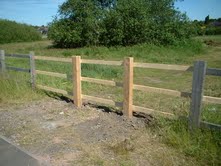 As gypsies moved off land near to Sandyford Cricket Club on Saturday 21st May, Councillor Martin Garner reported to S.A.G.E. that the fencing is now repaired. As gypsies moved off land near to Sandyford Cricket Club on Saturday 21st May, Councillor Martin Garner reported to S.A.G.E. that the fencing is now repaired.
Councillor Garner said that his concerns along with S.A.G.E. was that if the area is left open to access then the situation could be made even easier for the gypsies to get onto the land should they try again.
The councillor added that to get the fencing repaired, he has had to put plenty of pressure on the City Council to get the job done.
The last item we posted was 1870, a lot of water has passed under the bridge since then.
The population explosion has settled down, it has only increased from 3000 to 3183.
The Reverend Granville Rowe Bailey is the vicar at St John’s, Stanley Punshon Morris is his curate.
The Catholic chapel built in 1882 was dedicated to St Joseph and the priest was Reverend William J. Hopkins
The Baptist chapel at Latebrook was built in 1871 and remained open until 1956, my family on my dad’s side worshipped there.
My mum’s family were Methodists at the Dale Street chapel, so you can imagine that there was a little friction sometimes.
I was christened as a Baptist but went to the Methodist Sunday school every Sunday morning and Sunday afternoon until I was fifteen.
The principal landowners were, Sir Smith Child, J. H. Williamson and Sir Thomas Fletcher Boughey.
John H. Williamson is still manufacturing colour and chemicals for the pottery industry.
Ralph Sneyd of Keele Hall is still the Lord of the Manor.
Board School, or the Secondary Modern as it was called when I went there was built in 1884 with places for 400 boys and girls and 200 infants.
William Horrocks was the headmaster and Miss Sherwin was the mistress in charge at the infants.
Henry Gilbert was the master at the National School and Martha Wooliscroft the mistress at the National infants.
A Catholic school was built in 1872 to accommodate up to 200 boys and girls, Miss Jane Derbyshire was the mistress in charge.
Prominent people in the village are, Thomas Clare, Henry Gilbert, George Higginson, Frederick J. Jones, George Redfern, James Wearing and Miss Annie Williams.
This chap is definitely a first for Goldenhill, he is William Partington, M.D. and he’s a Surgeon.
I believe he graduated from Glasgow University in 1878 and practised at Goldenhilluntil his death in 1912 aged 62.
The Loopline railway had reached Goldenhill in 1874 and the station master was William Ledger.
According to records, horse drawn trams were in use from 1860 onwards and steam trams were introduced around 1881, this must have made life a lot easier, this is very good if you can afford the fares.
Electric trams didn’t arrive until 1899.
A quick rundown of current businesses for 1896 is as follows.
To read more on what it was like in Goldenhill in 1896, click the Forum Tab at the top of the page and click the Local Memories Page to read the rest of the article by David Wood.
Do you enjoy reminiscing about the past? Sharing your local history knowledge with friends and discussing how much Stoke-on-Trent has changed over the years? If yes then volunteering with the Closer to Home, Circular Walking Network could be for you.
With walks taking place every day of the week and in every corner of the city, the walking scheme takes in so many local history spots. As Closer to Home Walking Network Elise Butler explains “we are really keen to find volunteers who would enjoy leading our regular health walks, but who also have an interest in the local history of their area.”
She added “we are not looking for history experts. We are looking for people who want to pass on their knowledge about Stoke-on-Trent in order to enhance our walks which take place in areas such as Penkhull and Hanley.”
Regular walk leader and local historian Alan Myatt said “I’m interested in local history and have written several books about Blurton so I thought walk leading was a good opportunity to show people the history of the area and places that they never knew were there. On the walks I’ve met people I’ve not seen for years so it’s great to renew acquaintances and reminisce about what has changed.”
If you would like to find out more then join Alan and his fellow walk leaders on the historic Trentham Park walk every Wednesday at 2pm, leaving from the Harvester Inn near the old park gates, or call the ‘Closer to home, Circular Walks’ Team on 01782 831900, email: walks@stadiumcommunities.org.uk or log on to www.stadiumcommunities.org.uk
|
|




Recent Comments